(Solution) CIPD 5HR01 1.2 Similarities and differences of union and non-union employee representation
Solution
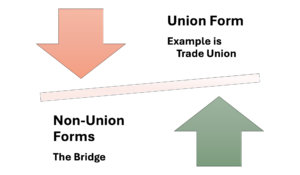
Union Form (Example is Trade Union)
A union form such as trade union is formally, collectively implemented operation intended to prioritise on the staff interests in regard to their rewards, terms and conditions in workplace, security at work and broad issues linked to employment. According to CIPD (2023c), union forms operate under very elaborate structure governed by the Trade Union and Labour Relations (Consolidation) Act 1992. As identified in Legislation.GOV.UK (1992), they work through involving employers, participating in collective bargaining, consulting and negotiations. Also, when there is a need for managing grievances or disciplinary process, the trade unions represent the employees.
For AnchorBridge, as they continue expanding their operations taking more facilities management business, there would be a necessity for building a platform for harmonious relations possible by engaging trade unions. According to CIPD (2025b), owing to their involvement at this phase where there are few challenges impacting on their relations, resisting at a later time would be reduced and collectively managing disputes.
Further, with Unions, fair practice would be guaranteed ensuring that there is full inclusion on policy work which relate to managing performance, disciplinary handling and redundancies in a consistent and legal manner.
For the future leadership as AnchorBridge expands to operate more contracts, constructively engaging in their operations involving trade unions assists in trust-based relations and working as partners. In AnchorBridge also, trade unions are important for a trust-based relations and partnering in their roles. This is by actively facilitating how they communicate, encourage adhering to set workplace needs. The AnchorBridge management would gain eventually with improved relations.
Non-Union Forms (The Bridge)
This is an example of non-union form involving employee’s representation. According to Naveed et al. (2025) the employees can actively consult and create a platform for employees and managers interact. In AnchorBridge, ‘the bridge’ represent a platform set I a voluntary manner for the sake of complying with consultation demands. According to CIPD (2025), the platform would be anchored on a legislation such as the Information and Consultation of Employees Regulations of 2004.
Comparisons
Please click the following icon to access this assessment in full