(Solution) CIPD Level 5 5HR01 AnchorBridge similarities and differences between union and non-union employee for the Senior Leadership Team (AC 1.2)
Solution
Unions
The union representation is informed by staff enrolling to trade unions bargaining for the sake of improving workplace condition, remuneration and overall job security (CIPD, 2025a). For instance, in AnchorBridge, trade unions could play a critical function linking employers and staff and protection for their collective bargaining needs. According to CIPD (2025b), the scope of inclusion of unions is offering support legally, advocating fairness and facilitate industrial action when need emerge. For example, in AnchorBridge dissatisfaction with recent 3% pay increase, trade unions could be engaged in ensuring that they maintain prevailing legislations including dismissal of employees in an unfair manner or contractual changes disadvantaging a staff. They are able to leverage on collective action meaning an increase in influencing outcome of making decisions in AnchorBridge. The scope of representation is noted in CIPD (2025a) to assist in increasing how confident they are for workplace relationships for assurance of fairness during AnchorBridge organisations change in their environment.
Non-Union
This represents a communication channel amongst staff for voicing their issues or participating in workplace decision making and with no enrolment to trade unions. For instance, CIPD (2020) identify Annual voice surveys in AnchorBridge as core to guide a set of discussions pertaining to challenges in workplaces, placing ideas on how to improve them and interaction actively. In AnchorBridge passing under change process, development of leadership could be facilitated by surveys for managing job security issues, restructure and set policy impacting Jim and Tola. Through the strategy, Arslan et al. (2022) note existence of open-based interaction amongst the management teams and employees, developing trust-based relations which are transparent.
Similarities and Differences
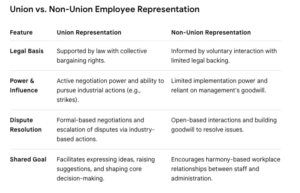
The union and non-union employee representation facilitates employees in expressing their ideas, make relevant suggestion and manage raised issues (CIPD, 2025b). This is for making core AnchorBridge organisation decision and voicing their input. Also, a facilitation of harmony-based workplace relationship through an encouragement of interactions amongst AnchorBridge staff and administration with all conflicts avoided and having input on employee’s involvement.
According to CIPD (2024b), they are distinct in terms of power and influence. For example, AnchorBridge unions are supported by law with collective bargaining rights allowing active negotiations for employment and pursuing industrial actions such as strikes based on need. This is different from non-union representation informed by voluntary interaction amongst management with limited legal implementation.
Additionally, the unions imply escalation of dispute by formal-based negotiations and industry-based actions with non-union strategies working by use of open-based interactions and managing their goodwill in resolving issues in work in AnchorBridge. According to ACAS (2022), the outcome entail ability to limit how they shape employment process.
For more insights, please click the following link