(Solution) 5CO02 Evidence-based practice Oakwood International
Solution
Briefing paper Questions
| (AC1.1) Evaluate the concept of evidence-based practice including how it can be applied to decision-making in people practice.
Short references should be added into your narrative below. Please remember to only list your long references in the reference box provided at the end of this section. Word count: Approximately 450 words |
| Definition
The goal of evidence-based practise (EBP) in the field of people practises is to help professionals make the most informed and prudent decisions possible by weighing available information. According to CIPD (2023), EBP encourages a systematic strategy that is based on an organization’s trustworthy information source. This method improves people practices by coordinating HR initiatives with overall business objectives. Additionally, it promotes a practice-based approach and encourages HR to think forward when making choices that will benefit both employees and the company. Evidence-Based Practice Utility Several clear benefits of EBP have been highlighted by Rousseau (2018).Time efficiency is the primary one. In a paragraph style, some of the merits of EBP include making the human resources profession more responsible and enabling professionals to make decisions based on facts rather than personal judgements. The fact that EBP is fact-based rather than based on assumptions or hypothetical claims is what sets it apart from previous approaches. Human resources can improve its input to the company and, by extension, provide more accurate and effective organisational support to people and management in particular, thanks to this factual information base. Drawbacks of EBP Although there are many benefits to utilising EBP, there are also some challenges.Time and maybe money will be required to gather and process the high-quality data. When dealing with human resources issues, it is common to require both quantitative and qualitative data, although the quality and relevance of the data might vary. Also, EBP isn’t always “blind” or insightful enough when it comes to HRM concerns; for example, it could not have enough quantitative data to draw conclusions. In addition, according to Sadler-Smith (2021), EBP may exclude minority perspectives if the data does not adequately represent them. Therefore, it is still crucial to enquire about and consider additional viewpoints, taking into consideration both statistical and non-statistical data. People Practice Issues Performance Human resources are better able to provide performance management and make informed decisions about staffing, candidate quality, and other resource efficiency-related matters thanks to evidence-based practice (EBP). For instance, by focussing on qualities that are proven to be associated with job success, evidence-based recruiting might enhance selection. Therefore, in order to accomplish organisational goals, EBP may be used to thoroughly examine demographic data and labour market statistics that indicate a lack of suitable skills inside the business. Improving recruitment validity through the use of copies of evidence-based practises can help eradicate bias in the selection of candidates. Resourcing Organisational Issue: Raising level of employee engagement. Using evidence-based practise (EBP) in people practises also increases employee engagement, which has a direct impact on productivity and morale. Leadership style, culture, and remuneration schemes are shown to correlate with involvement in SHRM (2023). As a consequence, HR managers may boost retention, motivation, and productivity by defining practises that contribute to staff satisfaction utilising EBP. Using evidence-based practice (EBP) to assess engagement activities improves the organisational work environment, which in turn encourages a healthy workforce through an effective sixteen best fit model.
|
| (AC1.2) Evaluate a range of analysis tools and methods including how they can be applied to diagnose organisational issues, challenges and opportunities.
Short references should be added into your narrative below. Please remember to only list your long references in the reference box provided at the end of this section. Word count: Approximately 400 words |
| The context in which organisations operate is a dynamic one that incorporates forces at both micro and macro levels. Studying such environments calls for the application of suitable tools and techniques. This section appraises one analysis tool and one method applied in people practise when identifying organisational dilemmas, problems and prospects.
Analysis Tool: PESTLE Analysis PESTLE (Political, Economic, Social, Technological, Legal, and Environmental) is a strategic tool used to analyse external macro-environmental factors affecting an organisation. It helps identify trends, risks, and opportunities that may influence decision-making processes in people practice (CIPD, 2023). Evaluation PESTLE analysis used widely to diagnose the external environment where the organisation operates because of offering all concerning external factors affecting the organisation. For instance, a technological change may bring chances of developing new human resource solutions, whereas a change that is legal may pose a threat to compliance. In people practise, this tool helps with mapping the HR strategies on the external factors like on readiness of the workforce for digital change. However, it actuality depends on the quality of the data collected, since poor data would result in wrong decisions. Strengths
Weaknesses
Analysis Method: Exit Interviews New participants’ exit interview is very useful in identifying organisational challenges and opportunities in people practise. For example, poor management or lack of growth opportunities are some of the feedback information that is consistent and can thus be said to require intervention. Also, knowledge of the factors leading to employee turnover derives ways of minimising similar issues with the existing staff. However, their effectiveness is only determined by the organisation’s capacity to provide a conducive environment for departing employees to give accurate feedback. Strengths
Weaknesses
|
| (AC1.3) Explain the principles of critical thinking including how you apply these to your own and others’ ideas.
Short references should be added into your narrative below. Please remember to only list your long references in the reference box provided at the end of this section. Word count: Approximately 450 words |
| A critical thinker is one who approaches ideas and situations creatively, rationally, and reflectively (CIPD, 2019). When making decisions or addressing problems, this ability is crucial, but it is particularly important in people practices because of the requirement for correctness, balance, and clarity. Both solo reasoning and group projects benefit from the fundamentals of critical thinking.
Clarity Presenting ideas in a clear and concise manner ensures that they are understood by everybody. By adhering to this approach, people professionals may better define their goals and keep the lines of communication open. Accuracy Accuracy is needed to cheque that the data collected is valid and not influenced by biases. While cross-checking information needed for people insights, professionals arrive at accurate, factual decisions reducing the chances of making wrong decisions significantly. Relevance Relevance concerns the use of information, which is more closely connected with the discussed subject. This ensures discussions are effective so that the business directs effort and resources into core areas of concern. Logical Reasoning In issue solving, the process of inference making is a key aspect that involves coming up with conclusions that are well backed by proper reasoning. It need lets the professional think through the notions and considerations critically and as per the goal line. Open-Mindedness They argued that in open-mindedness, one is able to take into account nonotherwise and weight them against, prejudice. This in turn helps people professionals to maintain a balanced and diversity and inclusive points of view on issues. Collaborating on ideas with people who think critically requires a systematic way of tackling problems. For instance, when assigned a project to enhance patient care at healthcare facilities, I was able to pinpoint which aspects, including staff-patient communication, need the most improvement. It was obvious that the problem needed to be defined. In order to get to the bottom of people’s genuine feelings, I polled doctors and their patients. Following this, the data underwent additional logical analysis and filtering to uncover patterns, probable problems, and potential remedies. It was easier to comprehend physicians, nurses, and patients if I kept my focus on the main goal and had an open mind. The level of satisfaction among patients increased dramatically once I developed a methodical strategy for addressing communication problems. Applying Critical Thinking Skills to Evaluate Other People’s Ideas Critical Thinking in Rational and Objective Debate
|
| (AC1.4) Explain a range of (2) decision-making processes.
Short references should be added into your narrative below. Please remember to only list your long references in the reference box provided at the end of this section. Word count: Approximately 400 words |
| Good decision-making, especially when confronted with tough choices, is essential for persons in people-related professions. The Decision Matrix and De Bono’s Six Thinking Hats are two popular methods for making decisions.
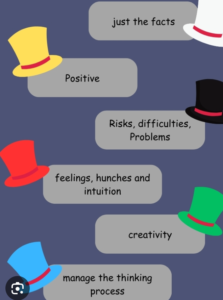
Decision Matrix De Bono’s Six Thinking Hats An innovative decision-making methodology, Six Thinking Hats is great for increasing cooperation and gaining different viewpoints on a subject. Every “hat” stands for a distinct way of thinking: In the white hat, facts and information are addressed, in the red hat, emotions and voices are heard, in the black hat, possible problems and drawbacks are considered, in the yellow hat, benefits and privileges are recalled, in the green hat, fresh ideas and viewpoints are shown, and in the blue hat, leadership and decision-making are carried out (Jamie, Patterson, Hall, 2022). This strategy is crucial for human resources professionals who are advocating for new policies or projects. Also, it’s helpful to think about everything that may be relevant; this guide encourages readers to put themselves in the shoes of those involved to ensure that all relevant factors, such as facts, emotional reactions, potential issues, and innovative solutions, are examined. Using a variety of perspectives, the Six Thinking Hats technique fosters an inventive atmosphere, which is essential for peak performance.. |
Please click the following icon to access this assessment in full