(Solution) AS2- Replication of CCS Projects
Solution
Contents
2.0 Data Analysis and Interpretations. 4
3.0 Forecasting method to determine the expected emission trend for the next four years 7
3.3 Interpretation and Analysis. 11
4.0 Inferential Analysis and Recommendations on Replicating the Aramis CCS Project in the UK. 12
5.0 Operational and Sustainability Implications. 14
5.1 Operational Implications of CCS Deployment 14
Figure 1: UK Total Greenhouse Gas Emissions 2013-2022. 5
Figure 2: UK Total Greenhouse Gas Emissions in Different Sectors 6
Figure 3: The Total Greenhouse Gas Emissions in Domestic Transport 7
Figure 4: Total greenhouse gas emissions (MtCO2e) (2013-2026) 11
1.0 Executive Summary
This report seeks to examine whether it is advisable for the United Kingdom to replicate the Aramis Carbon Capture and Storage (CCS) project, analysing trends in greenhouse gas (GHG) emissions from 2013 to 2022 and forecasting emission levels up to 2026. Over the past decade, UK emissions have declined from 566.9 MtCO₂e to 406.2 MtCO₂e, primarily due to progress in decarbonising the electricity supply and industrial sectors. Notably, transport emissions remain persistently high, making it the largest-emitting sector by 2022.
Forecasting using a linear trend model predicts a continued reduction to 324.4 MtCO₂e by 2026. However, the pace of reduction has slowed in recent years, signalling that current strategies alone are insufficient to meet the UK’s Net Zero 2050 goal. Inferential analysis confirms an average annual reduction of 16.98 MtCO₂e, highlighting the need for additional decarbonisation measures.
Carbon Capture and Storage emerges as a critical technology for addressing emissions from difficult-to-decarbonise sectors. Operationally, the UK benefits from substantial storage potential in the North Sea and existing industrial infrastructure, though financial, technical, and environmental challenges require careful management.
Recommendations:
- Prioritise CCS investment within industrial clusters where emissions are high and infrastructure efficiencies can be maximised.
- Implement rigorous safety, monitoring, and operational standards to mitigate the risk of CO₂ leakage and build public confidence in CCS solutions.
- Encourage international collaboration with countries experienced in CCS deployment, such as the Netherlands and Norway, to share technology, expertise, and regulatory practices.
- Integrate CCS with renewable energy strategies to offset the additional energy demands of capture systems and maintain emissions reduction momentum.
1.0 Introduction
The UK has pledged to become net zero for greenhouse gases by 2050, which means action and improvement in energy, transport and industry are needed urgently and over time. This report analyses whether the UK’s carbon reduction plan could include the Netherlands’ Aramis Carbon Capture and Storage (CCS) project. By examining old GHG statistics, model projections and analytical methods, it tries to measure how effective, essential and impactful CCS could be in the UK. It combines ideas from operations, finances and sustainability to deliver advice to help close the gap to the net zero goal.
2.0 Data Analysis and Interpretations
2.1 Data presentation tools
- i) Line Chart: UK Net Greenhouse Gas Emissions (2013–2022)
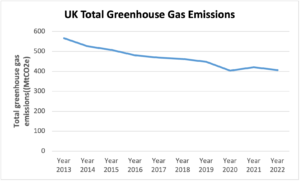
Figure 1: UK Total Greenhouse Gas Emissions 2013-2022
Over the past 10 years (between 2013 and 2022), the United Kingdom’s greenhouse gas (GHG) emissions consistently declined, falling from approximately 567 MtCO₂e in 2013 to 406 MtCO₂e in 2022. This downward trend reflects successful efforts in transitioning to renewable energy, phasing out coal, and improving energy efficiency across sectors (Tiseo, 2024). A sharp drop in 2020 was linked to COVID-19 restrictions, followed by a slight rebound in 2021 due to economic recovery, but emissions fell again in 2022. This trend indicates steady progress toward the UK’s Net Zero 2050 target, though further efforts are needed in harder-to-decarbonise sectors such as transportation. Such sectors are evident in Figure 2 below, which illustrates the UK Total Greenhouse Gas Emissions per sector.
- ii) Bar Chart: UK Total Greenhouse Gas Emissions Per Sector
.
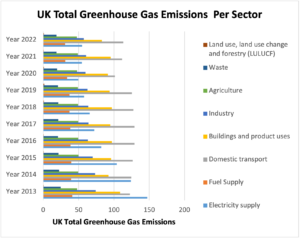
Figure 2: UK Total Greenhouse Gas Emissions in Different Sectors
A closer look at sector-specific emissions in Figure 2 reveals important insights. The electricity supply sector experienced the most dramatic decline, from 147.3 MtCO₂e in 2013 to just 54.9 MtCO₂e in 2022. According to Mayo (2024), this is largely due to the UK’s decisive shift away from coal-fired power generation towards renewable energy sources, as well as increased energy efficiency. Industry emissions also decreased from 74.1 MtCO₂e to 57.4 MtCO₂e over the period, indicating steady but more moderate progress. Emissions from buildings and product uses declined from 108.6 MtCO₂e in 2013 to 82.8 MtCO₂e in 2022, reflecting improvements in insulation and heating efficiency but also pointing to continued reliance on fossil fuels in the heating sector.
In contrast, domestic transport emissions remained persistently high, dropping only slightly from 122.8 MtCO₂e in 2013 to 113.2 MtCO₂e in 2022, as shown in Figure 3.
Figure 3: The Total Greenhouse Gas Emissions in Domestic Transport
As evidenced in Figure 3, transport has now become the highest-emitting sector in the UK, highlighting the challenges of decarbonising road travel and aviation. Meanwhile, agriculture and waste sectors saw relatively minor changes, with agriculture emissions being around 48 MtCO₂e and waste emissions dropping modestly from 24.5 to 18.8 MtCO₂e.
These trends suggest that while the UK has achieved meaningful emissions reductions in the power sector, further progress will depend on addressing more complex and harder-to-decarbonise sectors such as transport, heating, and industry. In this context, CCS technologies could play a crucial role (Majid, 2023). Projects similar to the Aramis initiative may be most impactful if focused on industrial emissions, transport fuel production, and domestic heating, where emissions remain substantial and where decarbonisation through conventional means is proving more difficult.
3.0 Forecasting method to determine the expected emission trend for the next four years
Please click the following icon to access this assessment in full