(Solution) Assessment ID / CIPD_5CO01_26_01 5CO01 Organisational performance and culture in practic
Solution
Table of Contents
1.1 Divisional and Matrix Structure for Artiron Motors. 2
Divisional Organisational Structure. 2
Matrix Organisational Structure. 3
1.2 Customer Preferences for Eco-Friendly Products. 4
1.3 Tariffs and Supply Chain Disruption on Artiron Motors. 5
1.4 Impacts of Robotics and CyberAttacks. 6
2.1 Shein’s Model of Organisational Culture. 8
2.2 People practice positively support innovative and inclusive culture. 9
2.4 Change management theory. 10
2.4 Change experiences by employees. 12
2.5 Employees wellbeing at Artiron Motors. 13
Factors impacting Wellbeing in Artiron Motors. 13
Importance to Adress the Factors. 14
3.1 Roles in People team at Artiron Motors. 14
3.2 People practices help Artiron Motors. 15
3.3 Artiron Motors Consult and Engage with Employees. 16
Answer to the Questions
1.1 Divisional and Matrix Structure for Artiron Motors
Divisional Organisational Structure
In this structure, it includes organising on basis of products, localities and services offered. According to CIPD (2025), this is distinct from being organised on basis of person specifications or job description of employees. In Artiron Motors, the structure include;
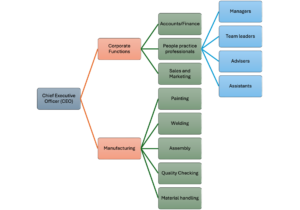
Figure 1: Artiron Motors Divisional Organisation Structure
For advantages, High Flexibility; with Artiron Motors engaging upto 50,000 employees, this structure enhances how flexible their operations are in manufacturing and corporate functions. Also, it enhances efficient handling of their customers in different sites in UK, Europe, US, Canada and China.
Innovativeness and Creativity– For Artiron Motors, collaboration of different functions are enhanced with different teams working together. For example, in Fraihat et al. (2023), finance teams are in a position of sharing data-based insights in different vehicles segments.
For their disadvantages, they are;
Teamwork affected– In Artiron Motors, with different divisions being stand-alone, their experts are confined to them hence reduced cross-interaction. The outcome is affecting team-based working.
Duplicated roles– As illustrated in Artiron Motors structure, the different departments have their support functions. For example, there is a receptionist department in each division hence duplicated across. This ends up lowering efficiency in interactions with all stakeholders.
Underpinning Rationale– For Artiron Motors, with an annual revenue of £25 billion and pre-tax profit of £2.1 billion, this is a large-scale organisation. As such, the divisional structure ensure that all the departments are working in collaboration. This is to manufacturer, support-roles and EVs development.
Matrix Organisational Structure
This is defined in Brukwe (2022) as a structure of reporting to different leadership classified as functional and divisional hence eliminating bureaucracy enhancing how flexible they are with resources-based sharing;
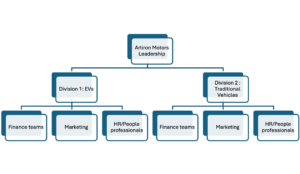
Figure 2: Matrix Organisation Structure
The advantages include;
Enhancing team-based working– By actively embracing matrix structure, individuals who possess distinct skills and knowledge collaborate actively. In Artiron Motors, teams from the traditional vehicles and the new Electric Vehicles (EV) manufacturing would come together for their success.
Enhanced adaptability– With Artiron Motors enhancing their adaptability to sustainability affecting manufacturing, support roles and developing EVs, adaptability is enhanced. This enhances resource utilisation with departments financing with no barriers.
The disadvantages include;
Lack of prioritisation– Having a matrix structure in Artiron Motors would lead to the EVs and conventional vehicles divisions popularising their operations. Conflicting priorities would be the outcome hindering resources management and set timelines.
Underpinning Rationale– With Artiron Motors interested to transition to sustainability, this structure would ensure that experts and resources are brought on board for successful operations.
1.2 Customer Preferences for Eco-Friendly Products
An organisation strategy is defined in CIPD (2025a) as the path undertaken by an organisation to achieve their objectives. The strategy guide how resources are allocated to achieve these objectives aligned with vision, mission and organisation values.
Artiron Motors Organisation Strategy– The organisation strategy dubbed “Evolve” is intended to enhance evolving nature of the organisation to become highly sustainable. The results of this strategy would include achievement of carbon net zero by 2036. This strategy has a direct impact on how they pursue manufacturing strategy, support-based roles and developing their new EVs.
Customer Preferences
The two customer preferences include;
- Affordability of the EVs/initial acquisition costs
- Efficiencies of the EVs in terms of their use and maintenance costs
For analysis, the VRIO Framework can be used which guide understanding how these preferences impact the organisation strategy internally and externally. According to Effendy (2025), this is a tool that prioritise on the factors of Value, Rarity, Imitability and Organisation.
Focusing on the identified customers preferences, the organisation strategy in Artiron Motors can entail an appropriate positioning to leverage on sustainable competitive advantage. Their internal resources (£25 billion) annual revenues and 50,000 human resources would be aligned appropriately. To ensure their EVs are affordable, their organisation strategy would entail investments in high-standards manufacturing operations and global contracts management standards for competitive parity owing to replicable scope of this category.
For the second preference which is efficiency of EVs use, Artiron Motors organisation strategy must be valuable, rarely available and inimitable. For example, they can work on developing a very high-quality technology of batteries, predictive AI technologies and easier diagnosis of maintenance services.
Integrated with their divisional and matrix organisation structures, their EV manufacturing would be easily embedded to their Evolve strategy. The outcome of this would be dominating their market operations, fulfilment of their clients’ expectations of less costs, low-level carbon emissions strategy.
1.3 Tariffs and Supply Chain Disruption on Artiron Motors
Tarriffs
Please click the following icon to access this assessment in full