(Solution) Avado 7C002 AC 4.2 People management challenges facing people management practitioners
Solution
Issues at Homestead
Homestead’s people management practitioners are challenged in a number of ways operationally and strategically as a result of a cost-based business model and a highly casualised workforce. One of the major challenges is poor workforce planning. Often is reactive instead of proactive which leads to understaffed stores that suffer from poor customer service and efficiency. According to Jaillet et al. (2022), this lack of proper planning also opens stores to security risks such as theft while also making it hard for store managers to manage workloads during peak periods. The lack of a structured workforce planning framework means that the organization is unable to align its people supply to business demand resulting in chronic absenteeism and burnout.
The second important issue is employee turnover and disengagement owing to poor remuneration and poor working conditions.
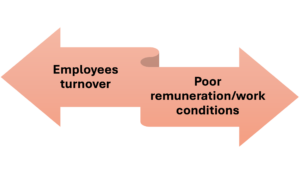
Homestead’s compensation, leave and benefits are based on statutory minimums, which does not ensure motivation and retention. Herzberg’s two-factor theory states that hygiene factors such as fair compensation and job security are required to ensure that no dissatisfaction occurs (Rai et al., 2021). The lack of these factors at Homestead has resulted in transient workforce, most especially among part-time and temporary workers, who are not loyal and dedicated. This continuous turnover not only raises the cost of recruitment but also compromises team cohesion and evenness of customer service.
Another key challenge is lack of training and development practices. On-the-job training is the only way of acquiring skills, and there is no structured induction or progression plan. As a result of this, employees’ competence levels have been low and their service delivery has been poor, especially since many of the employees have no prior experience in customer service. The lack of a learning culture also affects the internal talent development as the company depends on external hiring and this further affects the morale (Ritesh, 2023).
Adding to this, the centralised nature of HR and the low availability of HR presence in the field leads to a disconnect between HR and store-level operations. Store managers, most of whom are not trained in human resources practices, are expected to respond to complex employee relations problems on their own, oftentimes yielding inconsistent or even illegal outcomes (Young Kim & Kehoe, 2022). With this autonomy, a number of conflicts have emerged in the workplaces and it has been established that this lack of supervision and support from the human resource management has contributed immensely to the occurrence of these conflicts.
Lastly, trust and engagement levels have been eroded by the culture and management climate where employees have felt that they lack voice mechanisms and work within an aggressive culture. Contrary to contemporary participatory human resource practices which values inclusiveness and discussions, there is no avenue for staff to voice their concerns and have a part to play in the decision-making process. The lack of these communication channels has a psychological effect and stifles innovation (Dlamini et al., 2022).
In summary, the HR challenges of Homestead include weak workforce planning, low level of engagement, low level of training and disconnected HR structure. The organisation must further advance HR strategic role, improve retention conditions and have a culture of communication and capacity development at all levels in the stores. In all their stores they work in collaboration for successful business outcomes. An appropriate organisation culture is established of success and best relations.
Issues at Nestify
At Nestify, employee management practitioners operated in a contrasting environment of paternalistic culture and high employee loyalty. While the organisation maintained a positive employer image, several issues emerged as market conditions deteriorated. An important question was to balance fair working conditions with economic viability. Their wages were among the highest in the industry, benefits were more generous and they had significant help for their employees even when the business was unprofitable. For the HR practitioners, this caused tension between maintaining employee morale while dealing with the increasing labour cost (Nur et al., 2021).
Another major problem was how to manage change and organisational adaptability. Nestify’s traditions and family ownership developed a stable, but resistant culture. Employees were used to security and loyalty-based management and were thus less flexible to change as the market changed. HR practitioners had difficulties in implementing any restructuring measures or new working practices due to the expectation of on-going paternal support from the employees. This cultural inflexibility made it difficult to react to changes in technology and consumer behaviour, especially the emergence of e-commerce (Valentukevičė, 2023).
A further difficulty was that of succession and continuity of leadership. With no family members willing to take over
Please click the following icon to access this assessment in full