(Solution) Business Report in Oman Higher Education Sector
Solution
Assessing the Impact of Responsible and Sustainable Strategies on the Development of the Higher Education Sector in Oman: An Analysis of Stakeholder Responsiveness and Satisfaction
Executive Summary
This report analyses the role of responsible and sustainable initiatives in development of the higher education sector of Oman. The report uses PESTLE and SWOT analyses to analyse internal and external environment that influences the strategic priorities in the sector. The United Nations Sustainable Development Goals (SDGs) are determined as a suitable model to execute sustainability practices since they are related to Oman Vision 2040 and expanding global demands of institutions of higher learning. The report demonstrates the implementation of sustainability strategies by Omani universities in the form of ethical governance, sustainable operations in campus, curriculum integration and community involvement. It also examines the expectation and impact of the most important stakeholders and evaluates critically the relationship between sustainability practices and the responsiveness and satisfaction of stakeholders. The conclusion of the report is that sustainability strategies enhance the performance of the institutions, stakeholder confidence, and the sustainability in terms of competitiveness, yet issues of limited resources and poor implementation persist. It also gives recommendations to improve strategic integration of sustainability in the sector.
Table of Contents
Figire 1.1 QS World University Rankings of Omani higher education institutions. 2
2.0 Environmental Analysis of the Higher Education Sector in Oman. 2
Figure 2.1: The Components of a Company’s Macro-environment 3
3.0 Selection of a Responsible and Sustainable Strategies Framework. 5
3.1 Overview of the SDG Framework. 5
3.2 Suitability to the Higher Education Context in Oman. 5
4.0 SDG-Aligned Strategies in practise in the Higher education sector in Oman. 6
4.1 Sustainable Campus Operations. 6
4.2 Ethical Governance and Transparency. 7
4.3 Teaching and Research Sustainability. 7
4.4 Community and Industry Engagement. 7
Figure 5.0: Stakeholder Analysis- Internal Analysis. 8
5.1 Key Stakeholders in Oman’s Higher Education Sector 8
5.2 Stakeholder Expectations, Influence, and Responsiveness. 9
Figure 5.2: Stakeholder analysis 10
6.0 Critical Analysis: Strategies, Stakeholder Responsiveness, and Satisfaction. 10
6.3 Strategic and Long-term Effect. 11
1.0 Introduction
1.1 Background
Higher education sector in Oman has experienced a surge in growth since the 1970s to such an extent that it has a network of universities and colleges, both state-owned and privately owned, providing programmes in engineering, health, business, humanities and science. This expansion favours Oman Vision 2040 that focuses on economic development, innovation, and sustainable management of resources, all anchored on knowledge (Ministry of Higher Education, Research and Innovation (MoHERI, 2025). The development of human capital, productivity in research, and international partnerships are also developed by the university like Sultan Qaboos University (SQU) and an increasing number of the private universities. Oman Authority of Academic Accreditation and Quality Assurance of Education (OAAAQA) serves an important role in the quality assurance, governance, and national standards in institutions. Figure 1.1 represents the QS World University Rankings of Oman institutions of higher education in previous years, with SQU among others as their most significant performance.
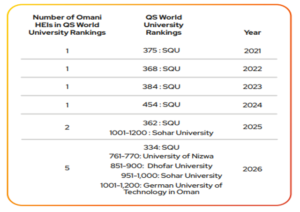
Figure 1.1 QS World University Rankings of Omani higher education institutions
Source: (MoHERI, 2025).
1.2 Scope of the Report
This report focuses on how responsible and sustainable policies affect the growth of Oman higher education sector. It conducts an environmental scan of the industry, implements a sustainability framework in line with the United Nations Sustainable Development Goals (SDGs) and discusses the practice on the university level. The responsiveness and satisfaction of the stakeholders are also critically examined and the obstacles to implementation are determined. The report ends by providing evidence-based recommendations in enhancing the integration of sustainability of higher education in Oman.
2.0 Environmental Analysis of the Higher Education Sector in Oman
The successful implementation of the responsible and sustainable strategies cannot be evaluated without the full overview of the higher education sector in Oman. To learn the factors that dictate the situation of an institution entails evaluating the external macro environment as well as the internal micro environment. (Lect3 MU AR, 2025). Here, the macro-environmental conditions affecting Omani higher education are analysed by means of the PESTLE framework. PESTEL analysis dwells on the key elements of strategic importance in the macro-environment, such as political forces, economic forces, sociocultural forces, technological forces, environmental forces, and legal and regulatory forces (Lect3 MU AR, 2025). The institutional realities, structural pressures, and strategic opportunities are established in the form of which sustainability-driven development is created in the PESTLE analysis.
2.1 PESTLE Analysis
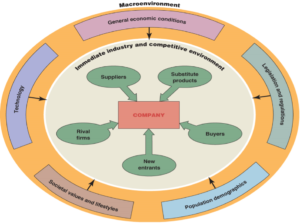
Figure 2.1: The Components of a Company’s Macro-environment
Source: (Lect3 MU AR, 2025).
On the political front, the sector of higher education in Oman is closely regulated by the Ministry of Higher Education, Research and Innovation (MoHERI) and the Oman Authority of Academic Accreditation and Quality Assurance of Education (OAAAQA). These organisations provide the strategic guidance of the universities by advancing responsible governance, research ethics, and quality assurance models in accordance with the Vision 2040 (Almaqtari, 2025). Political oversight, as David Hayden (2025) demonstrates, brings a sense of clarity and stability but the institutions will be required to continually change internal operations, especially governing and mandating responsibilities and data management, to respond to emerging requirements on sustainability and stakeholder participation.
Economic factors have a strong impact on institutional capacity. Government funding is paramount to the public universities whereas the tuition is the source of income of the private institutions. When fiscal tightening is implemented, the sector encounters difficulties with funding (Benlaria & Almawishir, 2025). Simultaneously, additional pressure on universities of diversified Oman to generate graduates who can benefit sustainable industries makes efficiency, innovation, and responsible operations.
Social expectations also define institutional behaviour. The students, employers and local communities are presenting an escalating demand of high quality education, equity, ethical conduct and environmentally friendly campuses. The internal pressure of the reform of the curriculum, open governance, and the role of the community has been strengthened by the awareness of sustainability of the young Omanis.
There are great growth opportunities in technological factors. Digital learning platforms, efficient campus systems that use low amounts of energy, and research technologies can help the institutions minimize waste, increase operational effectiveness, and improve teaching and learning. Nevertheless, digital gaps between institutions demonstrate internal fragilities that can curtail the level of progress across the industry.
Sustainability is supported by legal issues. The standards of the OAAAQA presuppose the demonstration of responsible management, ethical conduct, and pro-stakeholder planning (OAAAQA -Gov.om, 2023).
There are direct sectoral implications of environmental factors. The climate of Oman puts pressure on the water-demanding and energy-demanding university functions, and the shift in the approach to green buildings, sustainable landscape, and technologies consuming fewer resources starts.
2.2 SWOT Analysis
A supporting SWOT gives internal strengths, including governmental assistance and emerging research culture, and weaknesses including imbalanced expertise and lack of financing. These interplay with external opportunities (SDG integration, green technologies) and threats (regional competition, climate risks), which together form the viability and importance of sustainable strategies in the context of the entire higher education of Oman. The SWOT Analysis can be summarized as in the table 2.2 below.
Table 2.2 Summary
3.0 Selection of a Responsible and Sustainable Strategies Framework
In selection of responsible and sustainable Strategies Framework in the Oman higher education sector, this report uses the United Nations Sustainable Development Goals (SDGs) as the main strategic outline. Since the sector is mandate-based on the formulation of human capital, national innovation, and formation of the long-term socio-economic resilience, the SDGs give the sector a holistic framework through which universities and colleges are able to drive sustainability and at the same time fulfil the expectations of their stakeholders. An effective strategy results in sustainable competitive advantage, which arises when an attractive number of students, employers, and partners choose the services of an institution more than other options do- and the reason why this choice takes place is sustainable (Lect1 Introduction, 2025).
3.1 Overview of the SDG Framework
The SDGs are 17 global goals that tackled development issues that are interrelated. Universities are adopting the SDGs by integrating goals within their curriculum design, research focus, governing structures, and practises in the universities. Some of the goals used in higher education are SDG 4 (Quality Education), SDG 7 (Clean Energy), SDG 8 (Economic Growth), SDG 10 (Reduced Inequalities), SDG 12 (Responsible Consumption) and SDG 13 (Climate Action) (UN, 2025). As noted in Lect1 Introduction (2025) slides, the strategic techniques of the creation of sustainable competitive advantage, including the low-cost supplier, integration of the differentiating features, development of a narrow niche, expertise that is hardly imitable, are highly compatible with institutional change in SDG.
3.2 Suitability to the Higher Education Context in Oman
The SDGs are very applicable to the higher education system of Oman because they are very much aligned with the Oman vision 2040 and national priorities as expressed by the ministry of higher education, research and innovation. The White Paper highlights such key strategic pillars in the sector as sustainability, innovation, inclusive education, and global competitiveness (MoHERI, 2025). SDG 4 is a direct supporter of the high-quality and equitable education in Oman, and SDGs 7, 12, and 13 assure the national aspirations of energy efficiency, responsible use of resources, and climate-resilient development (UN, 2025).
Figure 3.2: SDG Goals
Source: (UN, 2025).
4.0 SDG-Aligned Strategies in practise in the Higher education sector in Oman.
Implementation of SDG-related practises in the Omanian higher education sector demands a broad approach that integrates sustainability within the operations of the campus, the administration and the community, as well as the academic activities. Increasingly, universities like Sultan Qaboos University (SQU) and the University of Technology and Applied Sciences (UTAS) are employing these ways to encourage national growth to sustainable development and enhance stakeholder satisfaction (MoHERI, 2025).
4.1 Sustainable Campus Operations.
The Omani universities have implemented the SDG principles especially SDGs 7, 12 and 13 with specific operation reforms that minimise environmental impact and enhance resource efficiency. The waste management activities such as organised recycling programmes and proper disposal of electronic waste are steps towards responsible consumption in line with SDG 12. The technology of water conservation, including smart irrigation and low flow fixtures, is used to solve the problem of water shortage in Oman, which is a sign of environmental stewardship in line with SDG 13.
4.2 Ethical Governance and Transparency
Please click the following icon to access this assessment in full
Related to: https://rankedprofessionals.com/downloads/solution-example-of-oman-research-project/