(Solution) Example of Oman Research Project
Solution
Impact of Responsible and Sustainable Strategies on the Development of the Higher Education Sector in Oman
Contents
3.0 Selection of a Responsible and Sustainable Strategies Framework. 5
3.1 United Nations Sustainable Development Goals (SDGs). 5
3.2 Suitability of SDGs Framework for the higher education context in Oman. 5
4.0 Application of Responsible and Sustainable Strategies in the Higher Education Sector. 6
4.1 Higher Education Sector in Oman. 6
4.2 Practical application of the strategies within universities or colleges. 6
5.1 Main stakeholders in Oman’s higher education sector. 7
5.2 Expectations, influence, and level of responsiveness to sustainability initiatives. 8
5.2.1 The Stakeholder Salience Model 8
5.2.2 Mendelow’s Power-Interest Matrix. 9
5.2.3 Stakeholder Engagement Ladder. 10
6.2 Reflection on institutional development and long-term success. 11
Figure 2: Main stakeholders in Oman’s higher education sector. 7
Figure 3: The Salience Model 8
Figure 4: The Mendelow’s Matrix. 9
Figure 5: Stakeholder Engagement Ladder. 10
Table 1: PESTLE Analysis of Oman’s Education Sector. 3
1.0 Introduction
The sector of higher education in Oman has turned into a strategic national priority due to the developments of the country toward the knowledge-based and innovation-based economy (Elshaiekh et al., 2025). In this connection, responsible and sustainable practices become progressively important in the context of institutional performance, stakeholders trust, and long-term development of the sector. As the expectations of the government, employers, students and society increase, Bhandari and Mohite (2024) note that sustainability is now a strategic imperative that has governance, operating and operational delivery implications. This report discusses the role of responsible and sustainable strategies in the development of higher education sector of Oman with reference to the environmental condition, using the established sustainability framework and assessing various stakeholder responsiveness and satisfaction. The study builds on strategic analysis to establish the critical relationship between sustainability practices and institutional effectiveness.
2.0 Environmental Analysis
The internal and external environment in the higher education sector of Oman is highly characterized by high-level of government guidance, rising societal expectations, technological disruption and pressure on responsible, sustainable educational practices (Shahzad and Shaukat, 2021). The knowledge of this environment is essential to identify how institutions can engage in practical sustainability practices that are not only favourable to national interests but also to stakeholder satisfaction. Here, SWOT and PESTLE analysis will be helpful.
2.1 PESTLE Analysis
This framework will review the broader macro-environment which influences higher education institutions in Oman whereby the strategic implementation of responsible and sustainable practices will be informed (DiLeo, 2024).
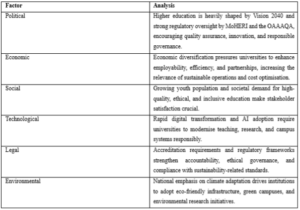
Table 1: PESTLE Analysis of Oman’s Education Sector
Source: Summarized from Mishra & Gupta (2021)
Overall, the evaluation shows that the Oman higher education industry is functioning within a highly regulated, socially driven, and technologically dynamic environment. Therefore, sustainable and responsible approaches are essential. The political priorities Vision 2040 helps institutions adopt sustainability in the governance and academic delivery to improve ethical leadership and transparency. The economic shifts towards the diversification mean that the universities must develop graduates who can work and are capable of employment, which corresponds to the establishment of green technologies and resource-efficient procedures. Social expectations of quality, inclusiveness and ethical behaviour put more social pressure on universities to show accountability and sustainable relationship with the communities. At the same time, the technological environment is rapidly changing, which contributes to the importance of digital sustainability, cybersecurity and responsible innovation. Legal requirements on accreditation support these expectations such as standardized quality and oversight. Finally, the environmental factors demand institutions to adopt sustainable operations in campuses such as the national climate policies.
2.2 SWOT Analysis
SWOT analysis takes into account both internal weaknesses and strengths, and external threats and opportunities (Kenton, 2024). It will demonstrate how the Oman sector can implement responsible and sustainable practices, and what challenges institutions need to confront to meet the expectations of stakeholders sufficiently.
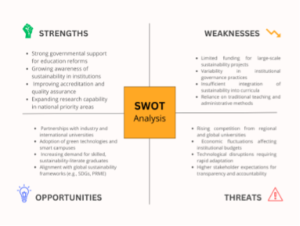
Source: Summarised from Al Kaf & Al-Issa (2022)
Generally, the analysis shows that the Omani sector of higher education has a good base to ensure that responsible and sustainable strategies are entrenched with regard to government reforms and improved quality assurance systems. Some of the strengths that provide a favourable environment with regard to the integration of sustainability in governance, teaching and operations in institutions are the increasing environmental awareness and emerging research capabilities. However, organizational weaknesses, particularly limited finances and lack of uniformity in the application of sustainability principles, demonstrate areas of strategic focus. International collaboration, the adoption of green technology, and adherence to global systems and structures are some of the opportunities that facilitate the institutional growth. In the meantime, threats such as competition, economic pressures and increased stakeholder expectations provide the justification of sustainability as a differentiator.
3.0 Selection of a Responsible and Sustainable Strategies Framework
3.1 United Nations Sustainable Development Goals (SDGs)
The United Nations Sustainable Development Goals (SDGs) provide a broad international framework that can assist organizations, governments and learning institutions to be socially responsible, economically feasible, and environmentally sustainable in their development. The 17 goals and 169 targets of the SDGs are interconnected and encourage a comprehensive solution to the global issues such as access to quality education, climate action, gender equality, responsible consumption and innovation (Carlsen & Bruggemann, 2021). When applied to the higher education institutions, the SDGs provide a systematic guide in which the aspect of sustainability is applied in institutional governance, academic programmes and research priorities and even in community engagement. According to Alamoush et al. (2021), they are cantered on collaboration, ethical leadership, long-term resilience and cross-sector partnerships, which are values aligned with the mission of universities. Importantly, the SDGs also urge institutions to embed the concept of sustainability into their organizational culture by strengthening their responsible decision-making mechanisms, providing learning opportunities that are inclusive, and fostering knowledge production that leads to national and global growth (Kohl et al., 2021). As a globally-recognised and adaptable strategy, the SDGs can be a strong strategic instrument to embed responsible behaviour in all aspects of the higher education sector.
3.2 Suitability of SDGs Framework for the higher education context in Oman
The SDGs are especially appropriate to guide responsible and sustainable interventions in the higher education sector in Oman since they are directly related to the national development agenda and the structural requirements of universities. According to Alhabsi & Alfawair (2023), Oman Vision 2040 puts a heavy focus on education quality, innovation, sustainability and human capital, priorities that directly align with several SDGs, particularly Quality Education (SDG 4), Decent Work and Economic Growth (SDG 8), Industry, Innovation and Infrastructure (SDG 9) and Climate Action (SDG 13). By adopting the SDGs, Omani universities can develop clear direction towards enhancing the relevance of the curriculum, research output, and impacts on the community in a way that reinforces national goals. The framework also serves the rising demand of transparency, ethical governance and stakeholder engagement which are gaining more significance in the regulated higher education environment in Oman (Al Alsibani and Al Eladl, 2024). Furthermore, the SDGs prompt the institutions to address such environmental issues as water scarcity, carbon emission, and the sustainable use of the resources, which become nationally relevant (Gyimah et al., 2023). The framework is adaptable and can be customized to suit the needs of different universities of varying scope and capability and therefore sustainability can be embraced at a rate that suits the institution. Finally, the SDGs will assist the Omani universities to become more competitive, establish global standing and enhance responsiveness and satisfaction of the stakeholders through measurable and socially-oriented progress.
4.0 Application of Responsible and Sustainable Strategies in the Higher Education Sector
4.1 Higher Education Sector in Oman
Please click the following icon to access this assessment in full
Related to: https://rankedprofessionals.com/downloads/solution-northampton-hrmm058-individual-written-report/