(Solution) CIPD Level 5 5HR01 AnchorBridge relationship between employee voice and organisational performance (AC 1.3)
Solution
Adopting the definition in Azevedo et al. (2021), employee voice enhance performance through an increased engagement, innovativeness and performance. AnchorBridge Employees have a likelihood of commitment and experiencing immense job satisfaction scope when they have a feeling of being listened contributing to increased retention. According to Abdullah et al. (2021), for AnchorBridge case with employees input increasing efficiency in offering the facilities services in schools, universities, offices, hospitals and airports, this is important.
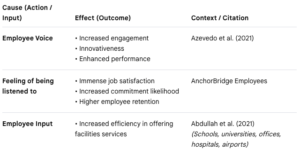
Further, Ashiru et al. (2022) hypothesise that employee voice has a positive implication in facilitating active decision making, offering insights to management from leading employees with direct relationship with other users. For instance, to ensure employees voice guide identification of issues in AnchorBridge 3% pay increase, wrongly use of nicknames and failure of representation in the employees relations team (Hosseini et al., 2022). Finally, the employees voice when done in an effectively structured forums and representation imply transparent relations, trust-based and team work hence AnchorBridge effectiveness and stable.
Arguments
Despite employee voice appreciation, their impact in AnchorBridge performance is not assured or appropriate. According to Abdullah et al. (2021), for business environment under consistent change, detailed consultation lead to reduced decision making and hence inefficient. Failure to adequately manage this contribute to increased conflicts as opposed to cohesive teams considering varying opinions could create tensed environment amongst the staff and leaders in AnchorBridge. In a different report by Harju et al. (2021), organisations possessing inappropriate leadership could encounter challenges in managing staff feedback leading to frustrated and lowly engaged individuals. Failure of integrating staff feedback in meaningfulness by the leaders in AnchorBridge lead to employees doubting on its success such as Jim and Tola relations. As evidenced in CIPD (2025a), this result to lost trust and morale for the entire organisation.
Judgement
The employee voice and organisation performance have a direct link informed by strengths and limitations in AnchorBridge. For instance, a holistic employee voice contributes to an increased engagement, innovativeness and trust-based relations in AnchorBridge. All these factors lead to an increase in performance in organisations. Conversely, according to ACAS (2021), inappropriate management or increased consultations contribute to frustrated teams affecting how they make decisions.
A case example is AnchorBridge going through various expansion in work councils, annual voice surveys, EDI networks and further channels such as hotline whistleblow which could embrace a highly structured employee voice including joint consultation committees allowing a coordinated strategy of obtaining feedback from staff with zero disruption of operations. Hence, in AnchorBridge it is advisable to Executive Team to continue investing in these types of voices. At the end, it is dependent on how leaders in AnchorBridge are committed towards achievement of employee voice and capacity for acting on two-way feedback provided meaningfully.
For more insights, please click the following link