(Solution) HRMM055 Management and Organisational Behaviour
Solution
Contents
2.0 Leadership and Management Challenges within Current Business Environment 2
2.1 Challenges of Leadership in Terms of Motivation. 2
2.2 Possible Ways of Addressing the Challenges in Tesco PLC.. 4
2.3 Challenges of Leadership in Terms of Conflict Management 5
2.4 Possible Ways of Addressing the Challenges in Tesco PLC.. 6
3.1 The analysis on Motivation. 8
3.2 The analysis on Conflict Management 9
4.0 Conclusion and Recommendations. 11
1.0 Introduction
This report critically examines key leadership and management challenges within Tesco PLC, specifically focusing on employee motivation and conflict management. As one of the UK’s largest retailers with over 300,000 employees, Tesco operates in a high-pressure, fast-changing environment. The COVID-19 pandemic exposed several internal vulnerabilities, especially in staff motivation and conflict resolution due to operational strain, unclear communication, and rapid restructuring. These challenges were exacerbated by the organisation’s digital transformation and cost-efficiency strategies.
The report will use organisational behaviour theories to analyse the roots of these challenges and propose practical solutions for sustained improvement. Herzberg’s Two-Factor Theory and Self-Determination Theory will guide the evaluation of motivational issues, while the Thomas-Kilmann Conflict Model and emotional intelligence frameworks will inform the conflict analysis. The report aims to contextualise how Tesco’s leadership practices influenced employee morale and workplace dynamics. To achieve this, the report will align theoretical approaches with real-time organisational issues.
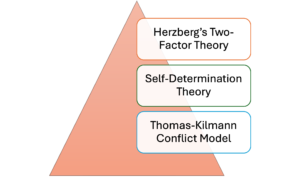
The analysis will be structured in three parts. First, evaluating the challenge of low employee motivation. The second part will involve addressing conflict management failures, and the third part will involve applying relevant theories to identify solutions. Finally, the report will offer recommendations to help Tesco create a more resilient and engaged workforce amid ongoing industry transformation.
2.0 Leadership and Management Challenges within Current Business Environment
2.1 Challenges of Leadership in Terms of Motivation
Motivating employees within a large-scale retail organisation such as Tesco presents complex leadership challenges, particularly in a post-pandemic environment. Having a diverse workforce that covers a wide array of functions, including front-line store workers and corporate teams, Tesco leadership has to respond to different expectations, working conditions, and motivation triggers. Among the primary problems, as Wang et al. (2023) note, is the inability to ensure employee motivation on a consistent basis because of the monotonous job roles, perceived lack of career progression, and limited recognition for frontline contributions, particularly in the context of the COVID-19 crisis.
The pandemic exacerbated the already existing issues by putting too much pressure on store employees without sufficient emotional or professional support. Although Tesco was publicly praised as one of the companies that did not close down during lockdowns, internal reports showed that there was a lot of dissatisfaction (Tesco plc, 2020). Employees complained that they were overworked, underappreciated, and unheard, despite taking on increased workloads and health risks. Leadership actions were concentrated on business continuation instead of employee welfare, and this aspect, as Salas-Vallina et al. (2020) point out, indicates a lack of intrinsic motivation measures.
Herzberg’s Two-Factor Theory can be helpful in explaining this problem. Although Tesco covered hygiene aspects like safety procedures and financial rewards, it lacked motivators like recognition, personal growth, and role enrichment (Brodie, 2025). Employees received short-term pay rises but no career development, training, or opportunities to make decisions. This demoralised employees and decreased long-term participation.
Also, the Self-Determination Theory (SDT) proposes that motivation flourishes when autonomy, competence, and relatedness are facilitated. Tesco had a centralised management structure, which reduced local managerial discretion and worker input, particularly in the introduction of new procedures or flexibility in scheduling. Chiu (2021) states that this undermined a sense of autonomy and personal agency among staff. Leadership decisions were perceived by many employees as being top-down and away from reality, especially when making emergency staffing adjustments and policy changes.
Moreover, the emphasis on efficiency and cost control by the leadership in the context of digital transformation initiatives unintentionally decreased employee participation and consultation. This, according to Ullrich et al. (2023), strengthened the perception that performance was valued over people, lowering psychological ownership and motivation. When customer satisfaction is strongly influenced by frontline engagement, Schleper et al. (2021) contends that these leadership gaps carry serious operational implications.
In summary, Tesco leadership has not been able to instill sustainable motivational practices beyond short-term incentives. A change towards empowering leadership, engaging staff in decision-making, and valuing non-financial contributions is needed. The intrinsic motivators can be addressed with the help of well-developed development plans, peer recognition plans, and participative leadership that will restore the level of motivation and drive long-term performance in the changing business environment.
2.2 Possible Ways of Addressing the Challenges in Tesco PLC
To address its motivation-related leadership challenges, Tesco must adopt a more strategic and people-centred approach. Short-term solutions like hazard pay and bonuses during the COVID-19 pandemic were appreciated but failed to sustain employee engagement. To enhance motivation, Akerele (2023) mentions that long-term practices that empower individuals, recognise contributions, and encourage internal growth opportunities are essential.
First, leadership at Tesco should implement job enrichment and redesign strategies. This, according to Knight & Parker (2019), will allow for broadening roles and allowing for more skill variety, autonomy, and task significance, which will help leaders increase employees’ intrinsic motivation. This aligns with Herzberg’s motivators, such as achievement and recognition, which are largely absent in Tesco’s current model. Rotating responsibilities, introducing task ownership, and offering micro-learning opportunities for skill development can enhance job satisfaction and reduce feelings of monotony (Oyeyipo et al., 2024).
Second, Third, decentralising decision-making and increasing leadership accessibility are critical. Local managers should be empowered to make timely decisions and customise motivational practices to their teams’ specific needs. As pointed out by Thøgersen (2021), this would improve autonomy, encourage innovation, and bridge the gap between senior leadership and frontline staff. Leadership visibility, town halls, and feedback loops can further encourage psychological safety and open communication.
Third, Tesco should develop structured internal mobility and career planning frameworks. Clear pathways for promotion, internal transfers, or specialised training signal that the organisation invests in its people. Similarly, Sugiarti (2021) explains that career development is a strong intrinsic motivator, particularly in a competitive retail sector where employee retention is a constant challenge. These initiatives would also support competence-building, as outlined in Self-Determination Theory.
Finally, leadership development programmes are necessary to build empathetic, emotionally intelligent managers who understand the value of motivation beyond productivity. According to Drigas et al. (2023), such leaders are more likely to create inclusive environments where employees feel heard, respected, and supported.
In summary, addressing Tesco’s motivational issues requires a fundamental shift in leadership mindset, one that balances operational performance with people development. These interventions, if consistently applied, will create a resilient workforce and reinforce employee commitment in the long term.
2.3 Challenges of Leadership in Terms of Conflict Management
Conflict is inevitable in large organisations like Tesco PLC, particularly during periods of rapid change, such as digital transformation and the COVID-19 pandemic. Leadership challenges in managing conflict have been especially evident, where Hubbart (2024) explains that poor communication, job security fears, and organisational restructuring have clashed with frontline employee expectations. These issues were intensified by Tesco’s increased reliance on self-checkout systems, perceived job threats, and inconsistent handling of safety concerns during the pandemic (Tesco PLC, 2023).
A major leadership challenge lies in identifying and addressing conflict early. Tesco’s traditional hierarchical structure often delayed the escalation of grievances, allowing minor disputes to escalate into widespread dissatisfaction (Tesco PLC, 2023). Employees reported a lack of transparency in decision-making and inadequate consultation, especially regarding shift changes, health measures, and technological rollouts. As a result, tension grew between employees and line managers, leading to decreased trust, absenteeism, and higher complaint levels.
The Thomas-Kilmann Conflict Mode Instrument (TKI) helps illustrate the shortcomings in Tesco’s conflict handling. Leadership often defaulted to avoiding or competing styles, ignoring conflicts or imposing top-down resolutions. According to McPheat (2025), these approaches may provide short-term clarity but often undermine collaboration and morale. A lack of collaborative conflict resolution created a perception among employees that their concerns were overlooked, further widening the gap between management and staff.
Additionally, emotional intelligence (EI), a key component of effective leadership, was inconsistently applied (Görgens-Ekermans & Roux, 2021). Many frontline managers lacked the training or support to navigate emotionally charged situations. Without skills in empathy, active listening, and self-regulation, leaders struggled to de-escalate conflict constructively. This not only strained manager-employee relationships but also diverted managerial focus from strategic tasks to dealing with daily operational disputes.
Leadership communication also played a critical role in conflict escalation. During the pandemic, inconsistent or delayed messaging regarding safety protocols and work expectations created confusion (Tesco PLC, 2023). Staff felt vulnerable and undervalued, with no clear forum to voice their concerns. This absence of inclusive dialogue reinforced feelings of isolation, particularly among lower-tier employees.
In sum, Tesco’s leadership had serious obstacles in dealing with workplace conflict. Unresolved tensions were due to the absence of early detection mechanisms, the inability to collaborate on solving problems, and poor emotional intelligence training. To minimise conflict in the workplace, the leaders should embrace proactive and emotionally intelligent strategies that emphasise open communication, transparency, and employee engagement. Such transformations are necessary to ensure unity and continuity of operations in a more complex retailing environment.
2.4 Possible Ways of Addressing the Challenges in Tesco PLC
The leadership style that Tesco should embrace in order to overcome its conflict management issues is proactive and emotionally intelligent. Historically, the company has been using top-down communication and avoidance-based conflict resolution which has proven to be ineffective, particularly when it comes to organisational change and crisis (Zhang et al., 2022). In the future, there are a number of strategies that are important to employ in order to enhance the way leadership manages internal conflict.
First, Tesco need to invest in organised conflict resolution training to all levels of
Please click the following icon to access this assessment in full
Related to: https://rankedprofessionals.com/downloads/solution-northampton-hrmm058-individual-written-report/